Search
Search our collection, stories, and categories.
Before the first brushstroke of colour is applied, a painting begins with its foundation — the canvas.
A properly prepared canvas provides the artist with a stable, consistent surface on which to work. Whether creating a traditional oil painting, an acrylic artwork or a contemporary mixed-media composition, preparation plays an important role in the quality and longevity of the finished piece.
At KUŠTRO Gallery, I believe understanding materials and techniques is an essential part of appreciating the art-making process.
Canvas is traditionally produced using cotton or linen, each offering different characteristics.
Cotton canvas is widely available, affordable and suitable for many painting techniques. Its relatively uniform texture provides a reliable surface for both beginners and experienced artists.
Linen canvas is often preferred for professional painting because of its strength, stability and distinctive surface texture. It can be particularly appealing for detailed work and traditional oil painting.
The choice depends on the artist's preferred medium, working style and desired finish.
Quality canvas should be properly stretched and secured to a suitable frame, ensuring the surface is firm without excessive tension.
One of the most important stages of preparation is applying a suitable primer.
Acrylic gesso is commonly used to prepare canvas for acrylic painting and, when specifically approved by its manufacturer, oil painting.
Gesso creates a more consistent surface, provides tooth for paint adhesion and helps control how the paint interacts with the canvas.
Applying paint directly onto untreated canvas can create problems, particularly when using oil paints, which require an appropriate protective ground.
Many commercially prepared canvases are already primed, but artists may choose to apply additional coats to achieve their preferred texture and absorbency.
Before applying primer, inspect the canvas carefully.
Check that the material is securely attached, the surface is clean and the stretcher bars are correctly assembled.
For an unprimed canvas, use a primer and preparation system compatible with the canvas and the intended painting medium.
Apply the first coat using a broad brush or suitable roller, following the manufacturer's instructions.
Work evenly across the surface, avoiding unnecessary build-up.
Allow each coat to dry according to the product instructions before applying another.
Where appropriate, lightly sand between coats to reduce raised fibres and uneven areas. Always follow the manufacturer's safety guidance and avoid creating airborne sanding dust.
The number of coats depends on the materials used and the surface the artist wishes to achieve.
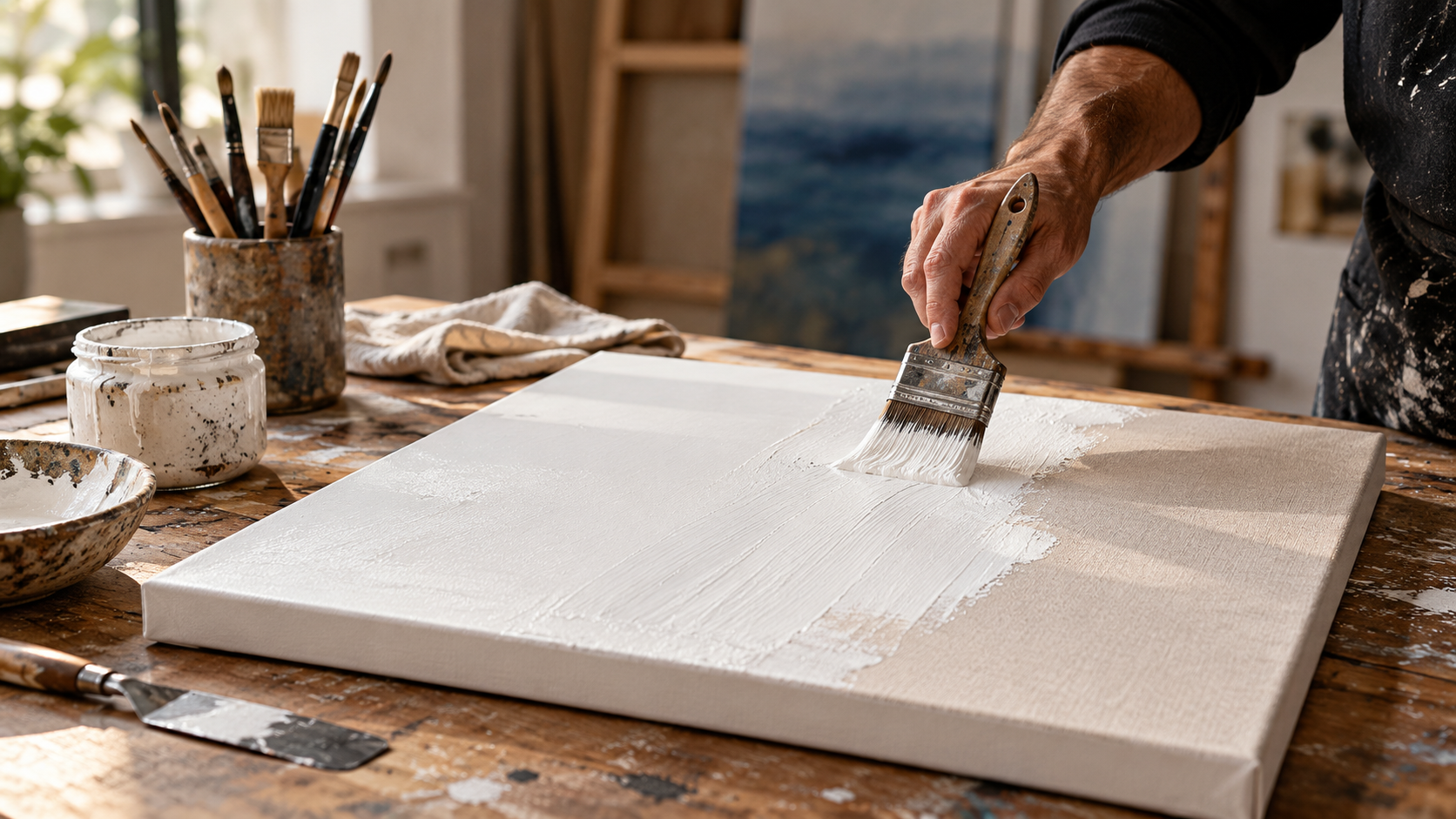
Different artists prefer different surfaces.
Some enjoy a smooth, almost polished ground that supports fine detail and delicate brushwork.
Others prefer a more textured surface that allows the canvas weave and expressive brushstrokes to remain visible.
There is no single correct surface for every painting.
The important consideration is creating a foundation suited to the artist's technique, materials and intended visual result.
Experimenting with different preparation methods can help artists discover how surface texture influences their work.
Canvas preparation is not always the most exciting part of painting, but it deserves attention.
Rushing the drying process, applying incompatible products or painting over an unstable surface can lead to problems later.
Good preparation allows the artist to concentrate on composition, colour and expression without being distracted by avoidable material issues.
Like many aspects of art, the process rewards patience and care.
There is something remarkable about standing before a blank canvas.
At first, it contains nothing but possibility.
Through preparation, drawing, colour and layers of paint, that empty surface gradually becomes an artistic statement.
Every decision contributes to the final result — from the materials selected to the smallest details of the composition.
For me, the creative journey is as important as the finished artwork.
The canvas is not simply a surface. It is the foundation upon which an idea takes physical form.
KUŠTRO Gallery celebrates artistic expression across a wide range of subjects, techniques and styles.
From one-of-a-kind original paintings to fine art photography and carefully produced limited-edition prints, each collection represents a different aspect of the creative journey.
Explore the Gallery: https://kustrogallery.com/